

How to Keep Your Energy Up All Year: A Whole-Body Guide to Feeling Your Best
At TruGevity Health + Wellness, a physician-led clinic on Coit Road in Plano for thyroid management, medical weight loss, peptide therapy, and hormone care, we spend a lot of time talking with women and men about one thing: energy. How to get it, how to keep it, and how to feel like yourself on a full calendar.
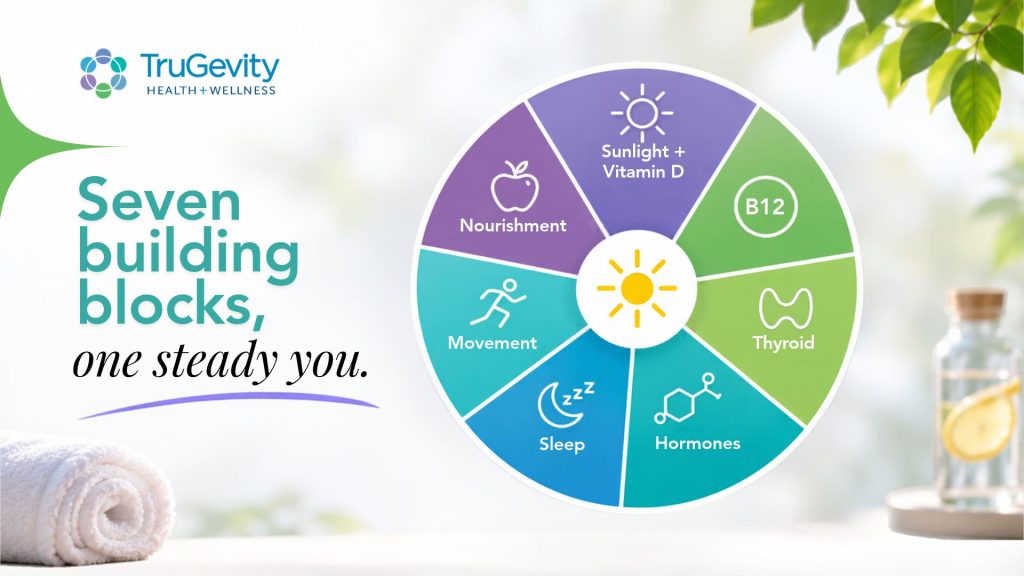
Steady energy comes from a handful of building blocks working together, from the sunlight you get and the nutrients you carry to your sleep, your thyroid, and your hormones. This guide walks through each one in plain language, shows how they shift through busy seasons, and explains how we help patients build a plan that keeps them feeling their best all year.
- Energy comes from several systems working together: sunlight and vitamin D, B12, your thyroid, your hormones, sleep, movement, and good nourishment.
- Shorter days, holiday calendars, travel and demanding work stretches can all pull on those building blocks at different times of year.
- Small daily habits make a real difference, and they give any plan a strong foundation.
- When you’d like a closer look, TruGevity checks your thyroid, hormones, and key nutrients together and builds a plan around you.
- Support can include vitamin D3, B12, NAD+ and glutathione injections, thyroid care, bioidentical hormone replacement therapy and peptide therapy.
- Every plan starts with a complimentary consultation, and we care for women and men at every adult age.
What gives your body its energy?
Every cell in your body runs on energy it makes from the food you eat and the oxygen you breathe. That process depends on a long list of helpers: vitamins that keep the machinery moving, hormones that set the pace, and a nervous system that rests and resets every night.
When those helpers are in good supply, you don’t think about energy at all. You wake up ready, you get through the afternoon without a crash, and you still have something left for the people you love in the evening.
It helps to picture energy like a household budget. Your thyroid sets the pace of spending. Your hormones shape how you sleep, how you feel, and how your body uses fuel. Nutrients like vitamin D and B12 are part of the income. Sleep is when the account gets topped up. Keep each of those in good shape and the whole budget feels comfortable.
The rest of this guide takes those building blocks one at a time, then puts them back together.
How do sunlight and vitamin D fit in?
According to the National Institutes of Health, your body makes vitamin D when your skin is exposed to sunlight, which is why it’s often called the sunshine vitamin. Vitamin D3 supports bone health, your immune system, mood, and muscle function, and it plays a part in your cardiovascular system and hormone production too.
Low vitamin D is common. According to the National Institutes of Health, about 1 in 4 adults in the U.S. have low levels. Working all day indoors, commuting before sunrise, and spending evenings at home all cut into the sunlight your skin gets.
Why it matters more in some seasons
When days are shorter, there’s simply less sunlight to go around, and a busy indoor schedule cuts into it further. The same thing can happen in the heat of a Texas summer, when it’s more comfortable to stay inside during the brightest part of the day. Vitamin D is worth keeping an eye on all year long.
How to support your vitamin D
- Get outside in daylight when you can, even for a short walk at lunch.
- Include foods that contain vitamin D, such as fatty fish, eggs, and fortified foods.
- Have your level checked so you know where you stand instead of guessing.
At TruGevity, vitamin D is one of the nutrients we check, and when it’s low, vitamin D3 injections can be part of your plan. Your provider sets the schedule based on your level and adjusts it as your numbers improve.
Why we check instead of guessing
Because vitamin D touches so many parts of your health, from your immune system to your mood and muscles, it’s one of the nutrients we look at when you come in. A simple blood test shows where you stand, so your plan is built on real numbers instead of guesswork.
What does B12 do for energy and focus?
Vitamin B12 helps your body make healthy red blood cells, which carry oxygen everywhere it needs to go. It also supports your energy levels, brain function, and cell metabolism.
Your body doesn’t make B12 on its own, so it has to come from what you eat or from supplements.
How B12 support works here
Checking B12 is simple, and it’s part of the nutrient picture we look at. When it’s low, a B12 injection is one of the quickest, easiest additions to a wellness routine. Your provider will talk through how often makes sense based on your level and how you’re feeling.
You can see the full list of our vitality injections, including vitamin D3, B12, NAD+, and glutathione, on our website.
How B12 connects to the rest of your health
Low B12 is one of the nutrient shortfalls that can affect how your thyroid produces and converts its hormones, along with selenium and iron. That’s one more reason we look at your nutrients and your thyroid side by side instead of one at a time.
How does your thyroid set your pace?
Your thyroid is a small, butterfly-shaped gland at the front of your neck. It makes hormones that help set the pace for your whole body: how quickly you burn energy, how warm you feel, how fast your heart beats, and how sharp your thinking is.
When it’s working at the right pace, you mostly don’t notice it. When it slows down, you might feel tired, a little cold and foggier than usual, with drier skin and hair and a scale that inches up. When it speeds up, you might feel jittery, warm, anxious, or wide awake at night.
It isn’t only a midlife question
Thyroid problems can start at any adult age, including your 20s and 30s. If your energy doesn’t match the way you live, your thyroid is worth a look no matter how old you are.
How we look at your thyroid
Instead of a single number, we run a fuller thyroid panel that shows how much thyroid hormone your body is making, how much is available to use, and whether your immune system is paying extra attention to your thyroid. We also look at the minerals your thyroid depends on. If your thyroid needs support, options include conventional thyroid medication and natural desiccated thyroid, such as NP Thyroid, when it’s appropriate, with rechecks to keep your plan on track.
Sherri, our thyroid and weight loss nurse, brings a background in women’s health and psychiatric nursing and a holistic approach that cares for both body and mind.
Signs your thyroid may be running too slow or too fast
An underactive thyroid, called hypothyroidism, can lead to fatigue, weight gain, dry skin, constipation, and feeling cold. An overactive thyroid, called hyperthyroidism, can cause weight loss, a rapid heartbeat, anxiety, increased sweating and heat intolerance. Hair thinning, brain fog, mood changes, and low libido can also be signs that your thyroid needs attention.
These changes can come on slowly, so they’re easy to get used to. If a few of them sound familiar, a fuller thyroid panel can show what’s going on and give you and your provider a clear place to start.
How do hormones shape energy for women and men?
Hormones are your body’s messengers. They affect energy, sleep, mood, focus, strength, libido, and the way your body stores fuel. As they shift with age and life stage, the way you feel day to day can shift with them.
For women
Estrogen, progesterone, and testosterone all play a part in a woman’s energy. During perimenopause, which can begin several years before a woman’s last period, these hormones tend to rise and fall rather than drop in a straight line. That’s why changes in sleep, mood, focus, and energy can come and go.
Testosterone matters for women, too. Women make it and rely on it for energy, strength, and libido, and it isn’t always part of a woman’s routine bloodwork. It’s one of the things we check.
For men
For men, testosterone is a big part of energy, drive, strength, and recovery. Testosterone decline typically begins in the late 40s or early 50s, though it’s different for everyone, and it can show up as fatigue, lower libido, mood changes, brain fog, lower motivation, or a loss of muscle.
How hormone care works here
Bioidentical hormones have the same chemical structure as the hormones your own body makes. At TruGevity, bioidentical hormone replacement therapy always starts with labs and a conversation about your symptoms and goals. The dose and the way you take it are chosen for you, then adjusted as you go. There are different ways to take them. For men, options include bioidentical testosterone pellets, oral troches, and creams, and your provider will help you choose the one that fits your routine.
How hormones and your thyroid work together
Your hormones and your thyroid talk to each other. Estrogen and testosterone levels can affect how your thyroid functions, and thyroid changes can show up as mood changes, low libido, and fatigue. That overlap is one reason the same feeling, like low energy or poor sleep, can have more than one cause.
It’s also why we look at them together. Checking your thyroid, hormones, and key nutrients in the same visit gives a fuller picture than any one of them alone, and it helps your plan address the right thing first.
Energy after a hysterectomy
If your ovaries were removed during a hysterectomy, your body’s main source of estrogen and progesterone is gone, and hormone changes can happen suddenly. Even if your ovaries were left in place, their function can change over time. Hormone support after a hysterectomy is something we’re glad to talk through, and it’s built around your age, your symptoms, and your health history.
Why is sleep your daily recharge?
Sleep is when your body repairs, restores, and resets. It’s also when the energy budget gets topped up for the next day. Good sleep makes everything else easier, and poor sleep makes every other building block work harder.
Hormones and sleep are closely linked. Night sweats can break sleep into pieces. A thyroid running fast can make it hard to settle. Shifting hormones in both women and men can affect how deeply you rest. That’s why sleep is one of the first things we ask about.
Simple ways to protect your sleep
- Keep the same bedtime and wake time most days, including weekends.
- Keep your bedroom cool, dark, and quiet.
- Get morning daylight, which helps set your body clock for the evening.
- Wind down from screens and work email a little before bed.
- Watch caffeine later in the day, especially during long workdays.
If something points toward a sleep issue that needs its own specialist, such as snoring with pauses in breathing, we’ll tell you and point you in the right direction.
Why you might wake up in the middle of the night
Waking up at the same hour each night, often warm or restless, is something we hear about from women and men alike. Shifting hormones can bring night sweats and lighter sleep. A thyroid running fast can make it hard to stay asleep. Stress, a late meal, alcohol, or a warm bedroom can all play a part too.
If you’re waking up regularly and can’t pinpoint why, jot down the time, how you felt, and what your evening looked like. A week or two of notes gives your provider a lot to work with.
How does what you eat affect your energy?
Food is fuel, and the kind of fuel matters. Meals built around protein, fiber, healthy fats, and colorful produce release energy more evenly than meals that lean on sugar and refined carbs, which can bring a quick lift followed by a dip.
Protein deserves a spot at every meal. It helps protect muscle, keeps you full longer, and supports steadier energy through the day. Fiber from vegetables, fruit, beans and whole grains helps too.
Don’t forget water
Even mild dehydration can leave you feeling sluggish and foggy, and it’s easy to miss during busy days, travel, or a dry, chilly stretch when you don’t feel as thirsty. Keep a water bottle close and sip through the day.
Where nutrition evaluation fits in
If you’d like a deeper look at how your body is using what you eat, our nutritional evaluation looks at the bigger picture, and it can be paired with the nutrient testing your provider orders.
Energy-friendly meal ideas
You don’t need a complicated plan. A few simple combinations that keep energy more even:
- Breakfast: eggs with vegetables and whole-grain toast, or Greek yogurt with berries and nuts
- Lunch: a big salad or grain bowl with chicken, salmon, or beans
- Afternoon snack: apple slices with nut butter, or cheese with whole-grain crackers
- Dinner: a palm-sized portion of protein, plenty of vegetables, and a smart carb like sweet potato or rice
If you have dietary restrictions or a health condition, your provider can help you tailor these ideas to you.
What role does stress play?
Stress is part of life, and short bursts of it are normal. When it stretches on for weeks or months, though, it can wear down your sleep, your focus, and your energy. Long-term stress can also affect how your thyroid works and slow your metabolism.
You can’t clear every stressor off your calendar, but you can give your body more chances to recover. A few ideas:
- Build short pauses into your day, even five minutes outside or a few slow breaths between meetings.
- Protect time for the people and activities that recharge you.
- Keep caffeine from standing in for rest.
- Say yes to help during demanding stretches, at work and at home.
Our medical director, Dr. Gomez, has a strong belief in the power of meditation and the influence it has on overall health, and a few quiet minutes a day count as one of the building blocks too.
How do movement and muscle help?
Movement gives energy back. A brisk walk can clear your head, and regular exercise helps you sleep more soundly, which feeds right back into how you feel the next day.
Muscle deserves special attention. It supports your metabolism, your strength and your balance at every age, and it’s something you can keep building well into later decades. Strength training a few times a week, even with simple bodyweight moves or light weights, is one of the best investments in long-term energy.
You don’t need a perfect routine. Choose movement you enjoy, start where you are, and build from there.
A simple weekly movement plan
If you’re not sure where to start, here’s an easy framework you can adjust to your schedule and fitness level:
- Two or three short strength sessions, working your legs, back, chest, and core
- A daily walk, ideally outside in daylight
- One longer activity you enjoy, like a hike, a bike ride, a class, or a round of pickleball
- A few minutes of stretching on most days, especially after long stretches at a desk
If you have a health condition or haven’t exercised in a while, check with your provider before starting something new.
Recovery counts as much as the workout
Strength is built during recovery as much as during the workout. Sleep, protein, rest days, and gentle movement on off days all help your muscles repair. If workouts are leaving you more drained than they used to, or recovery is taking longer, that’s worth mentioning at your visit. Hormones, thyroid function, and nutrients can all play a part.
What are NAD+ and glutathione?
These two come up a lot in conversations about longevity, so here’s the plain version.
NAD+
NAD+ (nicotinamide adenine dinucleotide) is a coenzyme that plays a crucial role in cellular metabolism and energy production. It supports cellular function and repair, and it’s a popular part of longevity-focused wellness plans for that reason.
Glutathione
Glutathione is an antioxidant that fights free radicals, the molecules that can cause cellular damage. It also supports your immune system and your body’s detox processes, and we recommend it alongside hormone replacement to support overall well-being.
Both are available as injections at TruGevity. Your provider will talk through whether either one fits your goals and how often it makes sense for you.
How they fit into a longevity plan
NAD+ and glutathione work best as part of a bigger picture. They pair naturally with good sleep, regular movement, steady nutrition, and, when it’s needed, thyroid or hormone support. Your provider will help you decide whether either one belongs in your plan and how often to come in.
How can peptides support rest and recovery?
Peptides are short chains of amino acids that your body already uses as signals. Depending on the peptide, those signals may influence processes involved in metabolism, tissue repair, inflammation, sleep, and recovery.
At TruGevity, peptide therapy is chosen for your goals and health history and prescribed after a consultation. For some patients, the goal is deeper rest. For others, it’s quicker recovery after workouts or support for body composition. Peptides can also pair well with a hormone or weight loss plan. Your provider will explain which options make sense for you, how they’re taken, and what to expect.
What to expect when you start
Peptide therapy starts with a consultation about your goals, your health history, and any medications you take. If a peptide makes sense, your provider will explain how it’s taken, how often, and what changes to watch for. We check in along the way and adjust as you go, the same way we do with every part of your plan.
How do the building blocks work together?
None of these pieces work alone. Low vitamin D can make it harder to feel motivated to move. Poor sleep can throw off hormones. A thyroid running slow can make even good habits feel like uphill work. When one building block slips, the others often feel the strain.
The good news runs the other way too. Improving one area often makes the next one easier. Better sleep makes it easier to exercise. Regular movement helps you sleep. Correcting a low nutrient can make your whole routine feel lighter.
That’s why we look at the whole picture instead of one number. Seeing your thyroid, hormones, and key nutrients side by side, along with how you sleep and live, shows where the best place to start is.
How do energy needs change through the year?
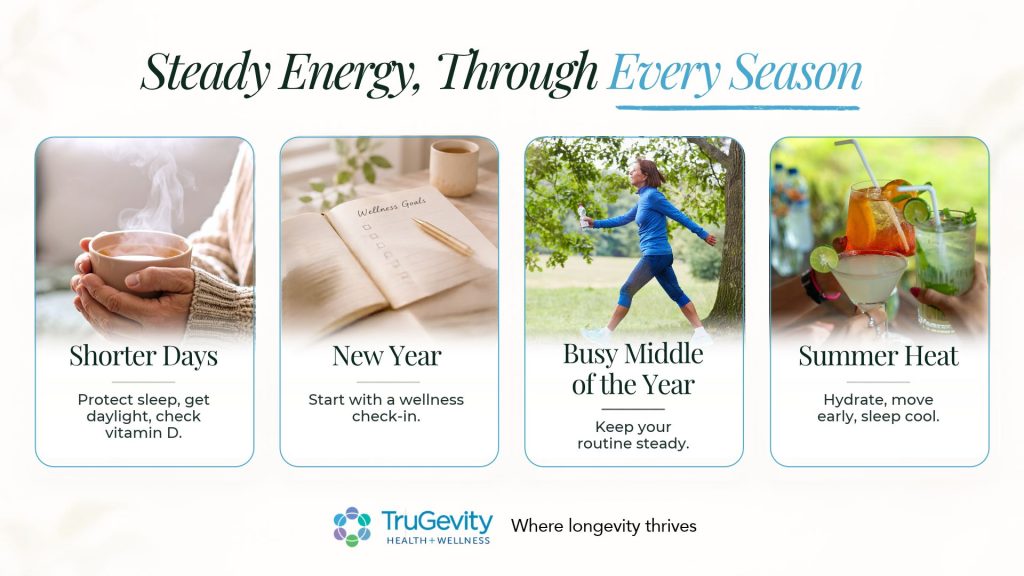
Every season asks something different of your body. Knowing what tends to pull on your energy at each time of year makes it easier to plan ahead.
Shorter days and the holiday stretch
Less daylight means less natural vitamin D, and darker mornings can make it harder to wake up feeling ready. Add holiday hosting, travel, year-end deadlines, and later nights, and sleep often takes the hit. This is a good time to protect your bedtime, get outside when the sun is up, and keep an eye on vitamin D.
A fresh start in the new year
The start of a new year brings energy of its own, and it’s a natural time to reset routines. A wellness check-in early in the year gives you a clear starting point, so your new habits are built on real information instead of guesswork.
Spring and the busy middle of the year
Longer days usually help, but packed schedules, school events, and travel can still crowd out sleep and regular movement. Keeping your routine steady through the busy stretch keeps your energy steady too.
Summer heat
In North Texas, summer heat can push activity indoors and make it easy to slip on hydration and sleep. Early-morning or evening movement, plenty of water, and a cool bedroom go a long way.
Whatever the season, the building blocks stay the same. What changes is which ones need a little extra care.
How can you keep your energy up through the holidays?
The holiday stretch is full of good things: gatherings, travel, traditions, and time with family. It’s also full of late nights, rich food, packed calendars, and year-end deadlines. A few habits help you enjoy all of it without running on empty.
- Keep your wake time steady, even after a late night, so your body clock stays on track.
- Eat a protein-rich breakfast before a day of parties or travel.
- Alternate holiday drinks with water, and keep a bottle with you when you travel.
- Schedule a walk after big meals, solo or with family.
- Protect one quiet evening a week with nothing on the calendar.
- Get outside in daylight during the shortest days of the year.
It’s also a smart time to schedule a wellness check-in, so you head into the new year with a clear picture of where you stand and a plan ready to go.
If you’re traveling
Travel can throw off your sleep, your meals, and your routine all at once. Pack snacks with protein, keep a water bottle with you, and try to get outside in daylight when you arrive, which helps your body clock adjust. If you’re crossing time zones, shift your bedtime a little in the days before you leave.
How do energy needs change at different ages?
Your body’s needs shift over the decades, and knowing what tends to come up at each stage makes it easier to stay ahead of it.
In your 20s and 30s
Careers are building, schedules are full, and sleep is often the first thing to go. Thyroid problems can start at this stage, and nutrients like vitamin D, B12, and iron are worth checking if your energy doesn’t match how you live. This is a great time to set habits that carry you for decades.
In your 40s and 50s
Hormones start to shift for women and men. For women, perimenopause can bring changes in sleep, mood, and focus. For men, testosterone decline typically begins in the late 40s or early 50s. Strength training and protein matter more now, and a fuller look at hormones and thyroid can help you understand what’s changing.
In your 60s and beyond
Staying strong, sleeping well, and keeping your nutrients in a good range all support independence and quality of life. Women and men in their 60s, 70s, and beyond still have hormone and thyroid questions worth answering, and we’re glad to help answer them.
What daily habits keep energy steady?
Small habits add up, and they make any plan work better. A few to build on:
- Start the day with daylight and water before coffee.
- Eat enough protein at each meal, which helps protect muscle and keeps energy more even.
- Build meals around whole foods, with plenty of color on the plate.
- Move every day, and add strength training a few times a week.
- Keep a consistent sleep schedule.
- Take short breaks during long workdays to stand, stretch, and step outside.
- Keep a simple energy and sleep journal so you can spot patterns.
If you’re already doing all of this and still don’t feel quite right, that’s useful to know. It tells us where to look next.
Is it a busy season or something more?
Everyone has stretches when the calendar wins. A demanding project at work, a new baby, a move, or the holidays can all leave you running lower than usual, and that’s normal. Energy that bounces back once things calm down is usually a sign your building blocks are in decent shape.
It’s worth paying attention when the busy season ends and your energy doesn’t come back with it. Signs to notice:
- A lighter week or a vacation doesn’t leave you feeling restored.
- You’re sleeping enough hours but still waking up tired.
- Focus, mood, or motivation feel different for longer than a few weeks.
- Workouts feel harder, or recovery takes longer than it used to.
None of these means something is wrong. They’re simply good reasons to check in on the building blocks and see which ones could use support.
When is it worth a closer look?
There’s no test you have to pass first. A conversation is a great next step if any of these sound like you:
- Your energy doesn’t match how well you’re sleeping, eating, and moving.
- You’ve felt foggy or flat for a few months, and rest isn’t changing it.
- Your sleep has changed, especially if you’re waking up warm or at the same hour each night.
- You’re in your 20s or 30s, and your energy or weight doesn’t match the way you live.
- You’re a man noticing less energy, lower drive, or slower recovery from workouts.
- Thyroid conditions run in your family.
- You’d simply like a clear picture of your health so you can keep feeling your best.
That last one counts. You don’t have to feel unwell to come in, and wanting to stay ahead of things is a perfectly good reason to book a visit.
What can a wellness check-in include?
Every visit is built around you, so the details vary. A wellness check-in at TruGevity can include:
- A conversation about your energy, sleep, mood, focus, and goals
- A fuller thyroid panel
- Hormone testing for women and men
- Key nutrients, such as vitamin D, B12, and iron
- A plain-language review of your results with your provider
You’ll leave knowing where you stand, what we’d suggest and why.
How to get ready for your visit
A little preparation helps you get the most from your first appointment. Write down how you’ve been feeling and when it started. Make a list of every medication and supplement you take, including doses, and mention biotin if it’s in a hair or nail product you use, since it can affect certain lab results. Bring any recent lab work from other clinics, and come with your questions. There’s no such thing as a silly one.
How does TruGevity build an energy plan?
Every plan starts with a conversation and ends with something built around you.
- A complimentary consultation. You talk with our team about how you’ve been feeling, your health history, and your goals. Bring any labs you already have.
- Lab work drawn right here. If testing makes sense, your labs are drawn in our office, so there’s no separate trip to an outside lab.
- Your results, explained. Your provider walks through what came back in plain language, so you understand your own health.
- A plan that fits you. That might include thyroid support, bioidentical hormone replacement therapy, vitality injections, peptide therapy, nutrition and sleep guidance, or a combination.
- Ongoing support. We check in, recheck when it’s time, and adjust as you go.
Our medical director, Dr. Cesar Gomez, has more than 35 years in medicine and makes sure every treatment approach is medically sound. You’ll work with a small team that knows your name and your history, and you’ll see the same friendly faces from visit to visit.
We also work alongside your existing care. You keep your primary care physician and any specialists you see, and with your permission, we’re glad to share results so everyone’s on the same page.
A plan made for you, and only you
At TruGevity, every health plan is personalized to the patient in front of us. We take the time to listen to your whole story, including how you’ve been feeling, what’s changed, what you’ve already tried, and what you’d love to feel like again. Nothing is rushed, and no question is too small.
That’s why no two plans look alike. For one patient, the focus might be bringing a low vitamin D level back up and protecting sleep through a busy season. For another, it might be thyroid support paired with B12 injections. For someone else, it might be bioidentical hormone replacement therapy alongside peptide therapy for rest and recovery.
Whatever your plan includes, you’ll have a small team that knows your name, cares about how you’re doing, and keeps checking in until it feels right. As one of our patients put it in a Google review, we’re “very focused on individual needs and making sure that those are met.”
What is it like to get a vitality injection?
Simple. Vitality injections are given right here at our Plano office by our team, and your provider will explain what each one is for before you start.
How often you come in depends on the injection and your levels. Your provider sets the schedule with you and adjusts it as your plan moves along. And as a thank-you, new consultations include a free B12 or glutathione injection.
Vitality injections pair well with the rest of a wellness plan, whether that’s thyroid care, hormone care, peptide therapy, or simply a routine that helps you feel your best.
What questions should you bring to your visit?
Any question is welcome. A few that help you get the most out of a first visit:
- Which of my building blocks would you like to check first, and why?
- Could my sleep, thyroid, or hormones be connected to how I feel?
- Would vitamin D, B12, or another injection make sense for me?
- How will I get my results, and who will explain them?
- What can I start doing at home right away?
Bring your old lab results too, from any clinic. A few years of numbers can show a helpful trend.
What do our patients say?
TruGevity holds a 5.0-star rating on Google from 100 reviews. A few in our patients’ own words:
“I highly recommend for both men and women who are looking to improve their overall health. Very focused on individual needs and making sure that those are met. All of the employees are very friendly.”
Michael T., Google review
“The personalized approach to wellness really sets TruGevity apart. They focus on helping you feel your best with treatments and recommendations tailored to your individual needs. The office is clean, relaxing, and creates a positive atmosphere from start to finish.”
Kimberley B., Google review
“I am very impressed with the excellent care they are providing. Me and my wife are very educated in functional and longevity medicine. I recommended this clinic to multiple friends already , come physicians too.”
Oguz Y., Google review
Every person’s experience is their own, and results vary. What stays the same is the time, attention, and care behind every visit.
How do you pay for wellness care?
Your first consultation is complimentary, so you can learn your options before deciding anything, and new consultations include a free B12 or glutathione injection.
Payment plans are available so you can spread out the cost of your care. Financing through Cherry includes a 0% interest option for 90 days, with no credit check required and same-day approval, and CareCredit is also accepted.
Your provider will walk you through what your plan includes before anything starts, so there are no surprises.
Who do we care for?
We care for women and men at every adult age. That includes adults in their 20s and 30s looking at thyroid care or medical weight loss, women from early perimenopause through the years well after menopause, and men who want their energy, drive, and strength back.
Some patients arrive with a specific concern, and others simply want a clear picture of their health so they can keep feeling their best. Both are welcome.
For partners and families
Sometimes a spouse, partner, or adult child is the one who finds us first. If you’re reading this for someone you love, the same complimentary consultation is waiting for them, and they’re welcome to bring you along to the first visit.
Where do our patients come from?
Our office is at 6853 Coit Road, Suite 100, in Plano, TX 75024. Patients come to us from across North Dallas and Collin County for thyroid care, hormone replacement therapy, vitality injections, peptide therapy and medical weight loss.
Collin County communities
- Plano
- Frisco
- McKinney
- Allen
- Prosper
- Wylie
- Murphy
Dallas and Denton County communities
- Richardson
- Addison
- Carrollton
- Lewisville
- The Colony
If you’re looking for a wellness clinic near you, or a place to get vitamin D and B12 support near Frisco, Allen, McKinney, or Richardson, we’re a short drive up Coit Road. We’re open Monday through Thursday, 8:00 AM to 4:30 PM.
Final thought
Steady energy comes from caring for the whole picture: sunlight and nutrients, sleep and movement, your thyroid and your hormones. Busy seasons will always come and go, and with the right building blocks in place, you can move through each one feeling like yourself.
If you’d like a clear look at where you stand and a plan built around you, we’d love to meet you. Schedule your complimentary consultation by calling (972) 460-0560 or visiting mytrugevity.com.