

The headline from November 2025 said FDA removed the black box warning from hormone therapy. What actually happened is slower and more specific. As of FDA’s own list, last updated October 30, 2026, nine brand-name menopause hormone products carry rewritten prescribing information. Six were approved on February 12, 2026, and three estradiol patches followed on October 30. Many other estrogen labels, including Premarin, Prempro and Climara, still print the full 2003-era warning today, so the leaflet in your cabinet may not match the news you heard.
TL;DR
FDA asked makers of menopausal hormone therapy on November 10, 2025, to take cardiovascular disease, breast cancer, and probable dementia out of the boxed warning. The relabeling happens one product at a time. FDA’s list of updated prescribing information, current as of October 30, 2026, names nine products: Prometrium, Divigel, Cenestin, Enjuvia, Minivelle, Vivelle, Vivelle-Dot, Estring and Bijuva.
Prometrium, Estring and Bijuva now carry no boxed warning at all. The six whole-body estrogen-alone products keep one boxed warning for endometrial cancer in a woman with a uterus. The cardiovascular and breast cancer risks did not leave the label; they moved into the Warnings and Precautions section.
Compounded hormones have no FDA label, so none of this applies to them. Whether hormone therapy fits you is a decision your prescriber makes with you.
Which Nine Products Have Been FDA Relabeled So Far?
Nine menopause hormone products had updated prescribing information approved by FDA as of October 30, 2026, according to the agency’s list of menopausal hormone therapies with updated prescribing information. Six were approved on February 12, 2026. The other three, all estradiol patches, were approved on October 30, 2026. Each approval date can be confirmed in the supplement history in Drugs@FDA.
“Whole-body” in this table is our plain-English name for FDA’s category of pills, patches and gels that act through the bloodstream, as opposed to products used only in the vagina. FDA’s own documents use the medical term for the same group.
| Product | What it is | FDA category | Approved | Boxed warning on the new label |
|---|---|---|---|---|
| Prometrium | Progesterone capsules | Progestogen alone | February 12, 2026 | None |
| Divigel | Estradiol gel | Whole-body estrogen alone | February 12, 2026 | Endometrial cancer only |
| Cenestin | Synthetic conjugated estrogens, A, tablets | Whole-body estrogen alone | February 12, 2026 | Endometrial cancer only |
| Enjuvia | Synthetic conjugated estrogens, B, tablets | Whole-body estrogen alone | February 12, 2026 | Endometrial cancer only |
| Estring | Estradiol vaginal ring | Topical vaginal estrogen | February 12, 2026 | None |
| Bijuva | Estradiol and progesterone capsules | Whole-body estrogen plus progestogen | February 12, 2026 | None |
| Minivelle | Estradiol patch | Whole-body estrogen alone | October 30, 2026 | Endometrial cancer only |
| Vivelle | Estradiol patch | Whole-body estrogen alone | October 30, 2026 | Endometrial cancer only |
| Vivelle-Dot | Estradiol patch | Whole-body estrogen alone | October 30, 2026 | Endometrial cancer only |
Compared with the many hormone products on pharmacy shelves in Plano and Frisco, nine is a small share. FDA said in its February 12 announcement that 29 drug companies had submitted proposed labeling changes, and that the first six covered each of the four hormone therapy categories.
The list is a moving target. Re-read it the week you refill, because the count above will be wrong once FDA approves the next batch.
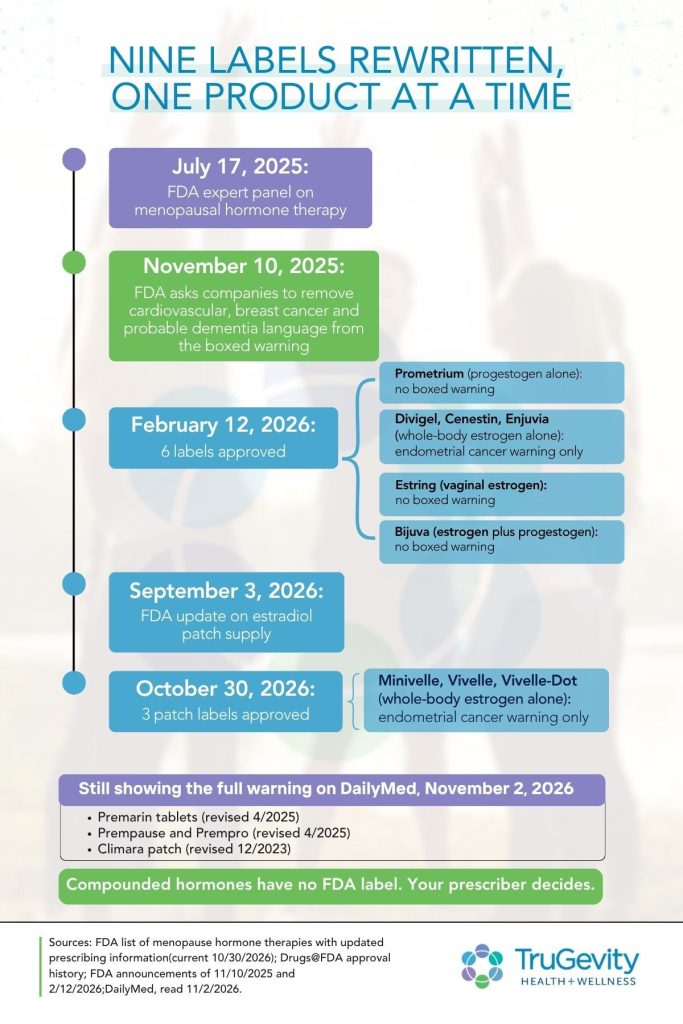
From a November Request to Three Patches in October
The change started as a request, not a rule.
On November 10, 2025, FDA wrote to the companies that hold menopausal hormone therapy applications and asked them to submit new labeling. Nothing on any shelf changed that day.
The sequence since then, from FDA’s own pages:
- July 17, 2025: FDA held an expert panel on the risks and benefits of menopausal hormone therapy, then opened a public comment period.
- November 10, 2025: FDA announced it was “initiating the removal” of the broad boxed warnings and sent the labeling requests.
- February 12, 2026: The first six labels were approved: Prometrium, Divigel, Cenestin, Enjuvia, Estring and Bijuva.
- September 3, 2026: FDA posted an update on estradiol patch supply after demand rose following the November action.
- October 30, 2026: Minivelle, Vivelle and Vivelle-Dot were approved, and FDA updated its product list the same day.
That is nearly a year from announcement to nine labels. Each manufacturer writes its own revision, FDA reviews it as a labeling supplement, and the new text only reaches the paper insert as fresh stock is packed.
Why the old warning existed
The labeling request explains the history plainly. Two Women’s Health Initiative studies began in the 1990s and stopped early: the estrogen plus progestin arm in 2002 and the estrogen-alone arm in 2004. Based on those findings, FDA began approving class-wide labeling changes in 2003, and the boxed warning grew to cover cardiovascular disorders, invasive breast cancer and probable dementia.
FDA now says the trials enrolled a population older than the women who typically start therapy for hot flashes. The November announcement put the average participant at 63. The labeling request puts the average age of menopause in the United States at 51.
What Left the Box, and What Stayed on the Label
The boxed warning is the black-bordered block at the top of a label, the most prominent warning FDA uses. For every menopausal hormone product, whole-body or vaginal, FDA’s labeling change request asked companies to remove the cardiovascular, breast cancer, and probable dementia language from that block. It also asked them to delete the long-standing advice to use “the lowest effective dose for the shortest amount of time.”
Here is the part the headlines skipped.
For whole-body products, the same request says to “retain information about cardiovascular diseases and breast cancer warnings.” Those risks are still on the label. They sit lower down, in Warnings and Precautions, where every other serious risk of a drug is listed.
Bijuva shows how that reads in practice. Its new label carries no boxed warning at all, yet its highlights still state that increased risks of pulmonary embolism, deep vein thrombosis, stroke and heart attack are reported with estrogen plus progestin therapy, and it still lists breast cancer or a history of breast cancer as a reason not to use the product.
| Label element | Before the 2026 revisions | On the nine revised labels |
|---|---|---|
| Cardiovascular disorders in the boxed warning | Yes | Removed |
| Breast cancer in the boxed warning | Yes | Removed |
| Probable dementia | Boxed warning and a Warnings section | Removed from both |
| Endometrial cancer in the boxed warning | Yes | Kept for whole-body estrogen-alone products only |
| “Lowest effective dose for the shortest amount of time” | Yes | Removed |
| Cardiovascular and breast cancer risks in Warnings and Precautions | Yes | Kept for whole-body products |
| Starting-age guidance | None | Whole-body products: consider starting under age 60 or within 10 years of menopause |
The one boxed warning that stays
Six of the nine products still open with a boxed warning: Divigel, Cenestin, Enjuvia, Minivelle, Vivelle and Vivelle-Dot. It reads “Endometrial cancer with unopposed estrogen in women with a uterus.” Estrogen taken alone can thicken the lining of the uterus, and each label says adding a progestogen has been shown to reduce the risk of endometrial hyperplasia. A woman who has had a hysterectomy is in a different position from one who has not, which is one reason the same product can be right for one patient and wrong for her sister.
Vaginal products got a shorter label
For local vaginal estrogen such as Estring, the FDA asked for something extra: condense the safety section and put first what matters for a low-dose product used in the vagina. The current Estring label opens with no boxed warning.
Is Hormone Therapy Safe Now That the Warning Changed?
Not for everyone, and the new labels do not say it is. The revisions describe risk more precisely; they do not remove it. The November announcement says the starting time and duration of therapy are decisions made between the prescriber and the individual patient, and that its labeled recommendation for whole-body therapy is to start within 10 years of menopause onset or before age 60. Your prescriber decides whether any hormone product suits you.
The new wording on the Divigel label is a good example. It says the timing of initiation “can affect the overall benefit-risk profile” and tells prescribers to consider starting the gel in women under 60 or within 10 years of menopause onset. Bijuva’s label uses almost the same sentence.
What still rules hormone therapy out has not changed much. The revised labels keep their contraindications, and the ones we read still list breast cancer or a history of it, along with active or past blood clots. A label change does not reopen a door that your own history has closed.
So the useful question for a woman in Allen or McKinney weighing hot flashes, poor sleep, or vaginal dryness is narrower than “is HRT safe now.” It is closer to this:
- How many years has it been since my last period, and how old am I?
- Do I still have a uterus?
- Is there breast cancer, a clot, a stroke, or liver disease in my own history?
- Which product, at which dose, and in what form (pill, patch, gel, or ring)?
- Is the label on that product one of the nine, or the older version?
Those answers come from a visit, not a press release.
Why the Leaflet in Your Cabinet May Still Show the Old Warning
Most likely because your product is not one of the nine. On November 23, 2026, the labels for Premarin tablets (revised 4/2025), Premphase and Prempro (revised 4/2025), and the Climara patch (revised 12/2023) on the National Library of Medicine’s DailyMed still opened with the full boxed warning. The Premarin tablets label on DailyMed names endometrial cancer, cardiovascular disorders, breast cancer, and probable dementia in its box.
There are three other reasons a leaflet can lag:
| Why your paper insert still shows the old box | What to check |
|---|---|
| Your brand has not had a revised label approved yet | Is it on FDA’s list of updated products? |
| You take a generic, which follows its brand’s label on its own schedule | The generic’s insert date and the brand it copies |
| The box was packed before the revision | The “Revised” date on the label |
| The online copy you read has not caught up | The Drugs@FDA label, which carries the approval date |
Online copies can lag too. A revised label can appear in Drugs@FDA before other websites update their copies, and a printed insert takes longer still to reach the pharmacy shelf.
How to read the date on your own label
Turn to the top of the prescribing information, under “Highlights.” A revised label in the newer format has a short block headed “Recent Major Changes.” On Bijuva it reads “Boxed Warning, Cardiovascular Disorders, Probable Dementia, Breast Cancer, and Endometrial Cancer removed 2/2026.” On Vivelle-Dot, the same block is dated 10/2026. Prometrium and Estring use an older label format with no Highlights section; on those, look for the 2/2026 revision date instead. If your insert has neither and still shows a four-part warning, you are holding the earlier version, whatever the news said.
Compounded Hormones Have No Label to Rewrite
Nothing in this change touches a compounded hormone. A compounded product is mixed by a pharmacy for one patient; it is not FDA-approved, so it has no FDA label, no boxed warning to remove, and no Recent Major Changes block. The nine revisions apply only to the approved products named on FDA’s list.
FDA is direct about the difference. Its consumer guidance says the agency has approved drugs containing hormones identical to the ones women make in their reproductive years. It also says many products marketed as “bioidentical hormones” are compounded drugs, and that FDA has no evidence that compounded bioidentical hormones are safer or more effective than FDA-approved hormone therapy. On estriol, FDA says no approved product contains it.
The word “bioidentical” therefore covers two different things. Prometrium is chemically identical to progesterone of human ovarian origin, according to its label, and it is FDA-approved. A compounded progesterone cream may use the same molecule and still have no approval behind it. Our page on pellets, troches and creams carries the same plain note: compounded bioidentical hormones are not FDA-approved and have not been through FDA’s review for safety, effectiveness or quality.
None of that makes a compounded hormone newly “warning-free.” It never had a federal warning, because it never had a federal label.
The Patch Shortage That Followed
Demand moved faster than supply. In its September 3, 2026 update on estradiol transdermal patches, FDA said demand rose after the November 2025 action, that it was working with all six patch manufacturers, and that supply of approved patches had nearly doubled over the past year. Some pharmacies still ran short of particular brands.
The agency’s advice for a missing patch is short:
- Ask your pharmacist whether another FDA-approved estradiol patch can be substituted.
- Talk with your prescriber about other options if your usual patch is out.
- Do not stop or change your medication without talking with your prescriber.
- Check back, because stock changes as new lots ship.
For a patient in Richardson or Frisco, that last line means a different store in the same chain may have what yours does not. It also means the patch you are handed could be a different brand from last month, with its own label and its own revision date.
Bringing the Label Question to Your Visit
The best use of this news is a specific conversation, not a general one. If symptoms that look like perimenopause are overlapping with fatigue or brain fog, our post on why normal labs can still leave you feeling off walks through how thyroid, hormone, and nutrient problems blur together.
A short checklist for the appointment:
- Bring the paper insert, or a photo of its first page.
- Note the “Revised” date and whether a Recent Major Changes block is there.
- Write down the date of your last period and whether you have had a hysterectomy.
- List your own history of breast cancer, blood clots, stroke, or liver disease.
- Ask which form your prescriber would consider, and why.
At our office on Coit Road in Plano, your provider reviews symptoms, health history, labs, and goals before any hormone plan is discussed, as our menopause hormone replacement care describes. You can see who does that work on our nurse practitioner and medical director’s bios.
Hold Your Own Label Up Against FDA’s Nine
Before your next refill, compare the name on your box with the nine on FDA’s list. If it matches, look for the 2/2026 or 10/2026 date in Recent Major Changes, or in the revision date on Prometrium and Estring. If it does not, the old warning on your insert is the current label for that product, and the change has not reached it yet.
Either way, the label is a starting point for a conversation with whoever prescribes for you. It does not decide whether hormone therapy is right for a woman in Plano, McKinney or Allen; her history does, and her prescriber reads that history with her. When you want that conversation with time to ask questions, TruGevity Health and Wellness sees women from across Collin County and North Dallas.