

At TruGevity Health + Wellness, a physician-led clinic on Coit Road in Plano for thyroid management, medical weight loss, peptide therapy, and hormone care, a first conversation can start with nothing more than a lab printout and a simple question: “If everything’s normal, why don’t I feel better?”
It’s a great question, and there’s usually a good answer. This article walks through what a routine blood test tells you, what a deeper look can add, and what it’s like to work with our team to figure out what’s going on. No medical degree required.
What does a “normal” lab result tell you?
Good news, first of all. A normal result means the tests that were run came back inside the expected range. Nothing on that list needs urgent attention, and that’s worth feeling relieved about.
Labs set those ranges by looking at results from a very large group of people. It’s a smart way to spot clear problems quickly. But a range describes a crowd, and you’re one person. Two people can have the exact same “normal” number and feel completely different.
So a helpful way to hear “your labs are normal” is this: the basics look fine. It’s a solid starting point. If you still don’t feel like yourself, it’s also a good reason to take a slightly wider look.
Why can you feel off when a routine test looks fine?
Because how you feel depends on a lot of systems working together, and a routine checkup is designed to cover the basics.
Think of your energy like a household budget. Your thyroid sets the pace of spending. Your hormones affect sleep, mood, and how your body stores weight. Nutrients like iron and B12 are part of the income. If one of them runs a little low, the whole budget feels tight, even when the main account looks fine on paper.
A routine thyroid check often looks at one main number. That number is useful, and we check it too. It just gives the headline without the full story. Sex hormones and key nutrients aren’t always part of a standard annual panel either, especially if you don’t bring them up.
What does your thyroid actually do?
Your thyroid is a small, butterfly-shaped gland at the front of your neck. It makes hormones that help set the pace for your whole body: how quickly you burn energy, how warm you feel, how fast your heart beats, and how sharp your thinking is.
When it’s working at the right pace, you mostly don’t notice it. When it slows down, life can feel like wading through water. You’re tired, a little cold, your skin and hair feel drier, and the scale inches up. When it speeds up, you might feel jittery, warm, anxious, or wide awake at night.
Your brain keeps an eye on all of this and sends signals telling the thyroid to make more or less. A routine test usually checks that signal. A fuller panel also looks at what the thyroid is actually producing and how well your body is putting it to use, which is why it can tell a more complete story.
What does a deeper look include?
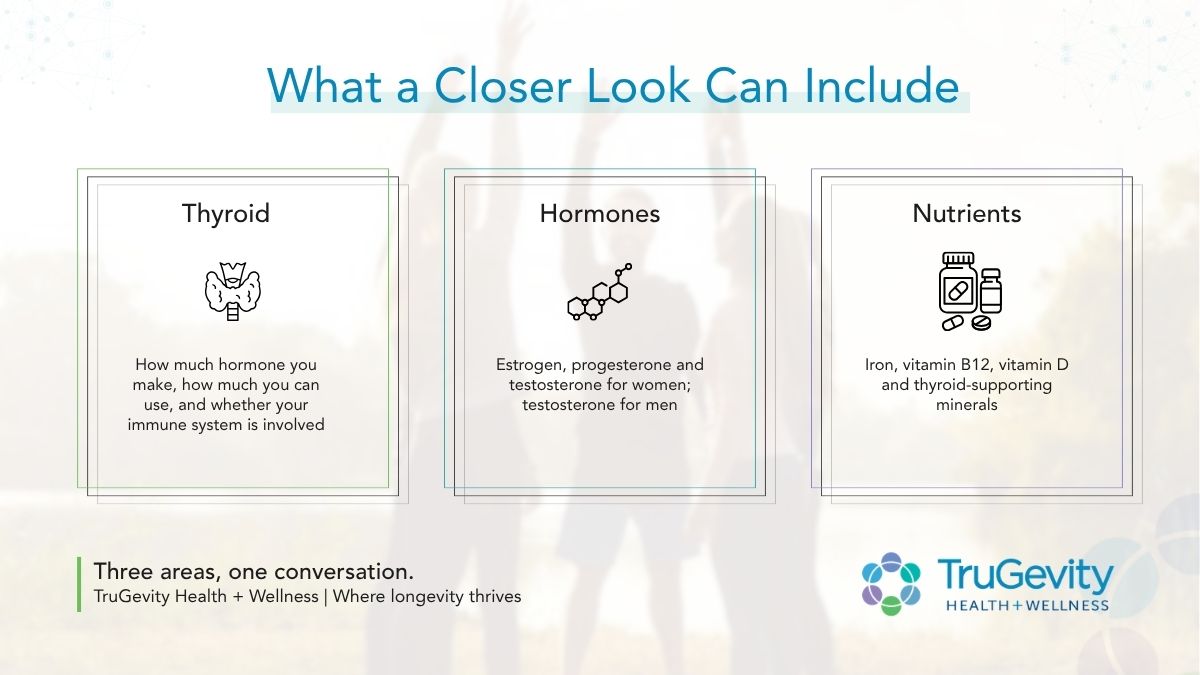
When we evaluate how you’re feeling, we look at three areas together instead of one at a time.
Your thyroid, in more detail
Instead of a single number, we run a fuller thyroid panel. It shows how much thyroid hormone your body is making, how much is actually available for your body to use, and whether your immune system is paying extra attention to your thyroid. The test names sound technical, but you don’t need to learn them. We’ll explain what yours mean in everyday language. You can read more about how we approach thyroid care on our website.
Your hormones
For women, that includes estrogen, progesterone, and testosterone. For men, it centers on testosterone. Hormones shift with age and life stage, and those shifts can affect energy, sleep, mood, weight, and libido.
Key nutrients
Iron, vitamin B12, vitamin D, and a few minerals your thyroid relies on. Running low on any of them can leave you feeling drained, and each one is simple to check.
Seeing all three together is what makes the difference. It’s a bit like looking at the whole map instead of one street.
How can thyroid, hormones, and nutrients feel so alike?
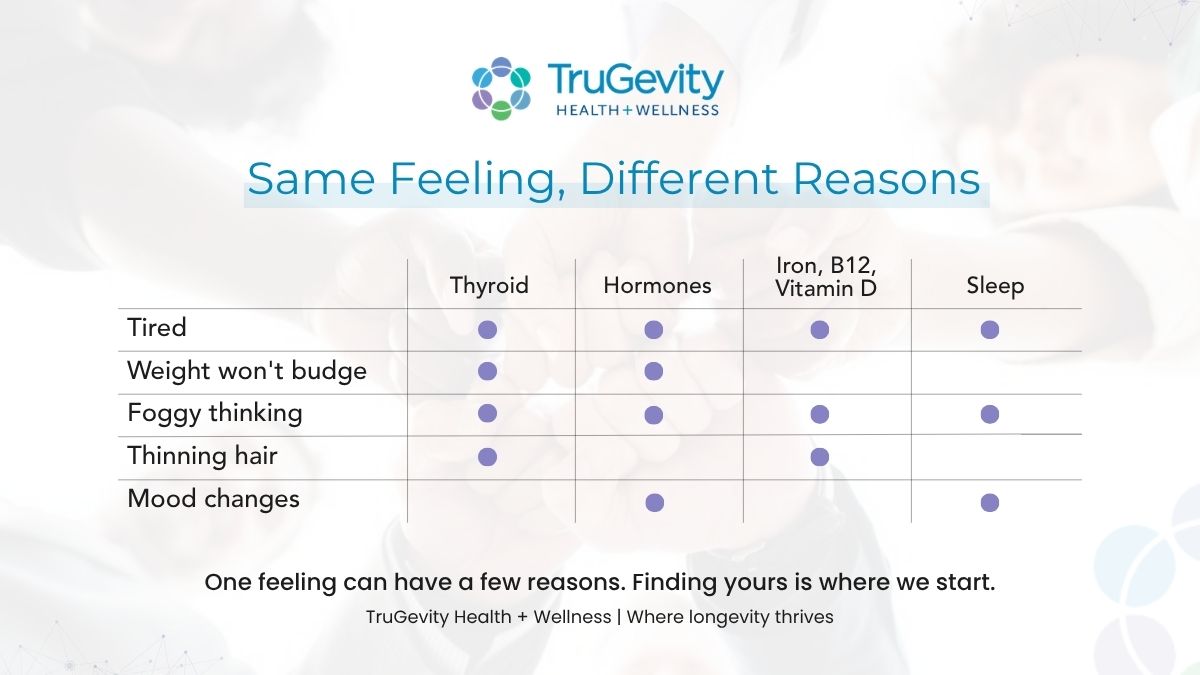
They all touch the same parts of your day. Energy, sleep, mood, focus, weight, and body temperature are shared territory, so a small shift in any one area can show up in familiar ways.
Here’s how a few everyday symptoms can connect to more than one cause:
- Tired even after a full night’s sleep: thyroid, hormones, iron, or B12
- Weight that won’t budge: thyroid, shifting hormones, or metabolism
- Foggy thinking: thyroid, perimenopause, sleep, or B12
- Foggy thinking: thyroid, iron, or hormone changes
- Mood that feels different lately: thyroid, perimenopause, or testosterone
That overlap is the whole reason we look at these areas together. It also means that once we find what’s going on, there’s often a clear place to start.
Perimenopause and menopause
Perimenopause can begin several years before a woman’s last period, and hormones tend to rise and fall rather than drop in a straight line. That’s why symptoms can come and go. Hot flashes, night sweats, lighter sleep, brain fog, a changing waistline, and a lower sex drive can all be part of it. So can fatigue, which is also a common thyroid symptom, so we look at both.
Once we understand where your hormones are, there are real options, from bioidentical hormone replacement therapy to support with sleep, nutrients, and weight. Women can move through this stage feeling steady, strong, and like themselves.
Testosterone matters for women, too
Women make testosterone and rely on it for energy, strength, and libido. It isn’t always part of a woman’s routine bloodwork, so it’s one of the things we check. One patient whose story is published on our website found low testosterone, low iron, and a thyroid on the low side of normal all at once. After getting all three addressed, she summed it up simply: “I finally feel alive.”
Every person’s story is their own, and results vary. But it shows why a wider look can be so worthwhile.
Iron, B12 and vitamin D
These are some of the easiest things to check and some of the most satisfying to fix. Low iron can make you tired and cause extra hair shedding. B12 supports energy and focus. Vitamin D plays a part in mood, immunity and muscle.
What does “bioidentical” mean?
You’ll hear this word a lot in hormone care, so here’s the plain version. Bioidentical hormones have the same chemical structure as the hormones your own body makes. Your body recognizes them the same way it recognizes its own.
At TruGevity, bioidentical hormone replacement therapy always starts with labs and a conversation about your symptoms and goals. The dose and the way you take it are chosen for you, then adjusted as you go. It’s care that’s built around your body rather than a one-size plan.
How does weight fit into all this?
Weight is often where people first notice that something’s changed, and that’s as true at 32 as it is at 52. You’re eating the way you always have and moving the way you always have, and the scale still creeps up.
Your thyroid helps set the pace of your metabolism, and shifting hormones at any adult age can change where and how your body stores weight. Sleep and stress play a part too.
If medical weight loss makes sense for you, our program pairs semaglutide or tirzepatide, started at a low dose and adjusted gradually, with regular check-ins, nutrition guidance, and Styku 3D body composition scans. Those scans show changes in shape and body composition, so you can see progress even on weeks when the scale is slow. Sherri, our thyroid and weight loss nurse, works across both areas, which means your thyroid and your weight plan are looked at together.
How do you know it’s time to come in?
There’s no test you have to pass first. If any of these sound like you, a conversation is a great next step:
- You’ve felt tired, foggy, or flat for a few months, and rest isn’t fixing it.
- Your sleep has changed, especially if you’re waking up warm or at the same hour each night.
- Your cycle has become unpredictable in your late 30s or 40s.
- Your weight has shifted without any change in how you eat or move.
- You’ve had a hysterectomy, especially if your ovaries were removed.
- Thyroid conditions run in your family.
- You’re in your 20s or 30s, and your energy or weight doesn’t match the way you live.
- You’re a man noticing less energy, lower drive, or slower recovery from workouts.
- You simply don’t feel like yourself, and you’d like to know why.
That last one counts. You know your body better than anyone, and “I just don’t feel right” is a perfectly good reason to ask.
What about the symptoms that are hard to bring up?
Some things are easier to talk about than others. A lower sex drive. Vaginal dryness. Discomfort with intimacy. These are real, common parts of midlife health, and they deserve the same attention as fatigue or sleep.
Vaginal dryness after menopause even has a clinical name, genitourinary syndrome of menopause, and it’s treatable. Here, it’s an ordinary thing to ask about. If saying it out loud feels awkward, write it on your symptom list and hand it over. We’ll take it from there, kindly.
Why do we ask about sleep?
Because good sleep makes everything else easier, and poor sleep makes everything feel harder. Night sweats can break sleep up. A thyroid running fast can make it hard to settle. Hormone changes in both women and men can affect how deeply you rest.
We’ll ask when you go to bed, when you wake up, and what wakes you in between. If something points toward a sleep issue that needs its own specialist, such as snoring with pauses in breathing, we’ll tell you and point you in the right direction.
What makes a visit here feel different?
Time, mostly. We built our visits around a real conversation, so there’s room to talk through the whole list, including the small things that don’t seem worth mentioning.
You’ll walk into a calm waiting room with a coffee bar, be greeted by name, and sit down with someone who has actually read your history. Your provider will explain what they’re thinking and why, and you’re always welcome to ask questions or take time to decide.
Our patients say it better than we can. One wrote on our testimonials page, “I left feeling heard, respected, and confident in my care.” That’s exactly what we’re going for.
What happens at your first visit?
It’s relaxed, unhurried, and built around you.
- A complimentary consultation. You talk with our team about how you’ve been feeling, your health history, and your goals. Bring any labs you already have.
- Lab work drawn right here. If testing makes sense, Stephanie Clevinger, our certified medical assistant and licensed phlebotomist, draws your labs in our office.
- Your results, explained. Your provider sits down with you and walks through what came back in plain language, so you leave understanding your own health.
- A plan that fits you. We’ll talk through your options together, including the option to wait and recheck if that’s the best fit.
- Ongoing support. We check in, recheck when it’s time, and adjust as you go.
We’re a small practice, open Monday through Thursday, and you’ll see the same friendly faces from visit to visit. That continuity is a big part of how we care for people.
What’s the lab draw like?
Quick and easy. It happens in our office, so there’s no separate trip to an outside lab. Stephanie has an exceptionally steady hand and a real knack for lightening the mood, which helps if needles aren’t your favorite thing.
Your provider will tell you ahead of time if you should come in at a certain time of day or skip breakfast, and whether to pause any supplements first. Biotin, found in plenty of hair and nail products, is one that can affect certain lab results, so let us know if you take it.
Who will you be working with?
- Cesar Gomez-Lozano, MD, Medical Director: An internist with more than 35 years in medicine who makes sure every treatment approach is medically sound.
- Ramona Weiss, NP-C, Board-Certified Nurse Practitioner: Twenty years as a nurse, including 15 in the Baylor Healthcare System, with a focus on weight loss, thyroid, and bioidentical hormone care.
- Sherri Gruden Botto, BSN, RN, Thyroid and Weight Loss Nurse: More than 20 years in women’s health. She helps patients understand their thyroid and wellness results and supports them along the way.
- Tracey Wiest, DC, ACN, Applied Clinical Nutritionist: More than 15 years in holistic nutrition, offering nutritional evaluation and Real-Time Live Blood Analysis.
- Stephanie Clevinger, Certified Medical Assistant and Licensed Phlebotomist: The steady hand behind every in-house lab draw.
What does a care plan look like?
Every plan is built around what we find and what you want. Here are some of the directions it can take.
Thyroid support
If your thyroid needs help, options include conventional thyroid medication and natural desiccated thyroid, such as NP Thyroid, when it’s appropriate. We also look at the nutrients your thyroid depends on, then recheck and fine-tune over time.
Bioidentical hormone replacement therapy
Bioidentical hormones are chemically identical to the ones your body makes. For women, that can mean estrogen, progesterone, and sometimes testosterone. For men, testosterone. There are different ways to take them, and your provider will help you choose one that fits your life.
Nutrient support
When a nutrient comes back low, correcting it can be one of the simplest wins in the whole plan. Our vitality injections include vitamin B12 and vitamin D3, and Tracey Wiest, DC’s nutritional evaluation looks at the bigger picture of how your body is using what you eat.
Medical weight loss
A supervised program with medication, check-ins, and body composition tracking, as described above, for patients where weight is part of the picture.
Peptide therapy
Peptides are short chains of amino acids your body already uses as signals. Specific peptides can be prescribed to support goals like recovery, sleep, body composition, or energy, and they often pair well with a weight loss or hormone plan. Your provider will explain which ones make sense for you, how they’re taken, and what to expect. Patients who want to go further can add NAD+ injections or aesthetic treatments like Exion and Emsculpt NEO.
How soon might you feel different?
It depends on what we find and what your plan includes. With thyroid care, some patients start noticing changes within a few weeks, with continued progress over a few months. Hormone therapy and nutrient support each have their own pace, and it’s normal for a plan to be fine-tuned after your first follow-up.
We’d rather be honest about timing than promise a date. What you can count on is that we’ll keep checking in and adjusting until the plan fits.
How do we stay with you over time?
Feeling better is a process, and we’re there for all of it. For thyroid care, we monitor and adjust about every six months once things are steady. Hormone therapy includes regular check-ins, especially early on. If weight is part of your goals, our program includes Styku 3D body composition scans, so you can see progress beyond the number on the scale.
Each time, we compare your new results to your earlier ones and ask how you’re actually feeling. Your numbers and your day-to-day life both count.
What if everything comes back normal again?
Then you’ve still learned something valuable. A fuller set of results that all look good rules a lot out, and that’s genuinely reassuring. It also helps point the conversation toward other things that affect how you feel, like sleep quality, stress, nutrition, or activity.
We’ll talk through what we’d suggest next, whether that’s a few changes to try, a recheck down the road, or a referral to another specialist who can help. You won’t leave empty-handed or unsure of your next step.
What does feeling like yourself again look like?
It’s different for everyone, and it tends to show up in ordinary moments. Getting through the afternoon without a crash. Sleeping through the night. Having the patience and energy for the people you love. Clothes fitting the way they used to. Wanting to go out on weekends again.
One patient described it this way: “I can have fun with the twins without feeling like I’m just pushing through my days.”
We can’t promise a specific outcome, and everybody responds differently. What we can promise is a thorough look, a clear explanation, and a team that keeps working with you until the plan fits.
What questions should you bring?
Any question is welcome. A few that help you get the most out of a first visit:
- Which of my symptoms could be connected?
- What would you like to test, and why?
- How will I get my results, and who will explain them?
- What are my options if something comes back low?
- What happens at my follow-up, and when is it?
Bring your old lab results too, from any clinic. A few years of numbers can show us a helpful trend.
What can help while you’re getting answers?
A few simple habits give any plan a head start:
- Keep a steady sleep schedule, with the same bedtime and wake time most days.
- Add some strength training. Muscle supports metabolism at every age.
- Eat enough protein, especially if you’re working on weight.
- Keep a short symptom and sleep journal to bring to your visit.
Is there a right age to look into this?
The right time is whenever symptoms start getting in the way of your life. Perimenopause can begin in the late 30s. Women in their 60s, 70s, and beyond still have hormone and thyroid questions worth answering. Men’s testosterone tends to drift down gradually starting in the 30s, and a lot of men feel it by their 40s. We care for men in their 30s and up. Thyroid problems can start at any adult age, including your 20s and 30s, and we welcome younger adults for thyroid care and medical weight loss.
What does care look like for men?
Plenty of men come in for the same reasons women do: less energy, less drive, workouts that don’t pay off the way they used to, a shorter fuse. Our men’s care starts with comprehensive labs, looking at testosterone alongside thyroid, nutrients, and metabolism, because energy is rarely about just one thing. Medical weight loss and peptide therapy are open to men too, and they can be combined with testosterone care when it makes sense.
When testosterone therapy is a good fit, there are options, including pellets, troches that dissolve in the mouth, and creams. Your provider will help you find the one that suits your routine.
Sometimes a spouse or partner is the one who finds us first. If you’re reading this for someone you love, the same complimentary consultation is waiting for them.
What is Real-Time Live Blood Analysis?
It’s a chance to see a drop of your own blood under a microscope, in real time, while Tracey Wiest, DC, explains what she’s looking at and how it relates to nutrition. Patients enjoy it because it makes health something you can see, not only read about.
It’s an educational and nutritional tool that pairs with Tracey’s nutritional evaluation. It doesn’t diagnose disease and doesn’t replace standard lab work.
How do we work with your other doctors?
Side by side. You keep your primary care physician, your OB-GYN, and any specialists you see. We’re the place you come for a deeper look at hormones, thyroid, and metabolism, with more time for the conversation.
We’re happy to review labs your other doctors have already run, so you aren’t retested without a reason. With your permission, we’ll share results and plans so everyone’s on the same page. And if something belongs with another specialist, we’ll say so and help you get there.
Where do our patients come from?
Our office is at 6853 Coit Road, Suite 100, in Plano, TX 75024. Patients come to us from across North Dallas and Collin County for hormone replacement therapy, thyroid care, menopause care, and medical weight loss.
Collin County communities
- Plano
- Frisco
- McKinney
- Allen
- Prosper
- Wylie
- Murphy
Dallas and Denton County communities
- Richardson
- Addison
- Carrollton
- Lewisville
- The Colony
If you’re looking for a hormone doctor near you, or a place to get a full thyroid panel near Frisco, Allen, McKinney, or Richardson, we’re a short drive up Coit Road. We’re open Monday through Thursday, 8:00 AM to 4:30 PM.